
Tebing Tegallingah Temple, A Quiet Gem in the Pakerisan River Valley, Bali
Wigobali.com – Bali has many ways to make people fall in love with it. There are beaches with sunsets, cafes bustling late into the night, and temples that always make it onto tourists’ itineraries.
However, in Gianyar, there is a place that offers a different experience: an ancient temple hidden amid dense forest and the flowing waters of the Pakerisan River.
Its name is Tebing Tegallingah Temple. Although it is not as popular as Goa Gajah or Gunung Kawi Temple, this site holds a special appeal in its tranquility.
Visitors need to descend around 300 steps, passing along a path partially covered in moss, before reaching a valley with rocky cliffs that preserve traces of ancient Balinese civilization.
The journey is certainly not as easy as stopping by an ordinary tourist destination.
However, for lovers of history, archaeology, and cultural tourism, Tegallingah offers an experience that goes beyond simply looking at old structures.
Tracing the Footsteps of Civilization Along the Pakerisan River
Tebing Tegallingah Temple is located in the Pakerisan River area, one of Bali’s historic landscapes that has held great significance for community life and religious activities since ancient times.
The river water was used for daily needs and irrigation, while also serving as an important part of the spiritual traditions of the Balinese people.
It is no surprise that this area preserves various archaeological remains, ranging from Gunung Kawi Temple and Goa Garba to the Yeh Pulu stone reliefs. Goa Gajah is also located not far from the area.
Among these sites, Tegallingah stands out for its more secluded atmosphere.
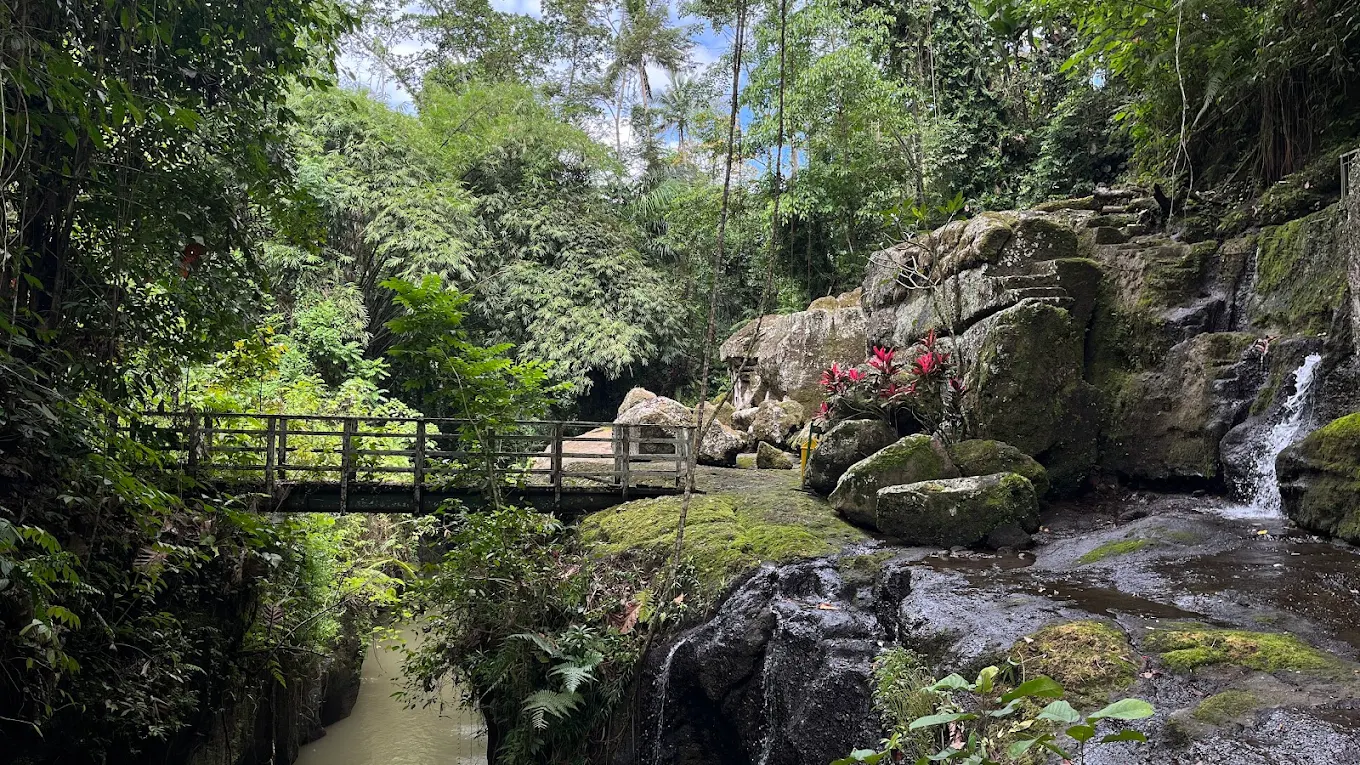
The complex follows the natural contours of the rocky cliffs along the riverbank, blending with dense trees and the sound of water flowing below.
There is no excessive sense of grandeur. Instead, what stands out is the close connection between the structures, nature, and a spiritual space that has endured for centuries.
Three Hundred Steps to a Sacred Place

The journey to Tegallingah begins on a quiet village road. After passing through the entrance, visitors must descend around 300 steps toward the Pakerisan River valley.
Ferns grow between patches of soil, climbing plants hang from the trees, while moss covers parts of the path.
The farther visitors descend into the valley, the more the village atmosphere gradually fades, replaced by the sounds of nature and the flowing river.
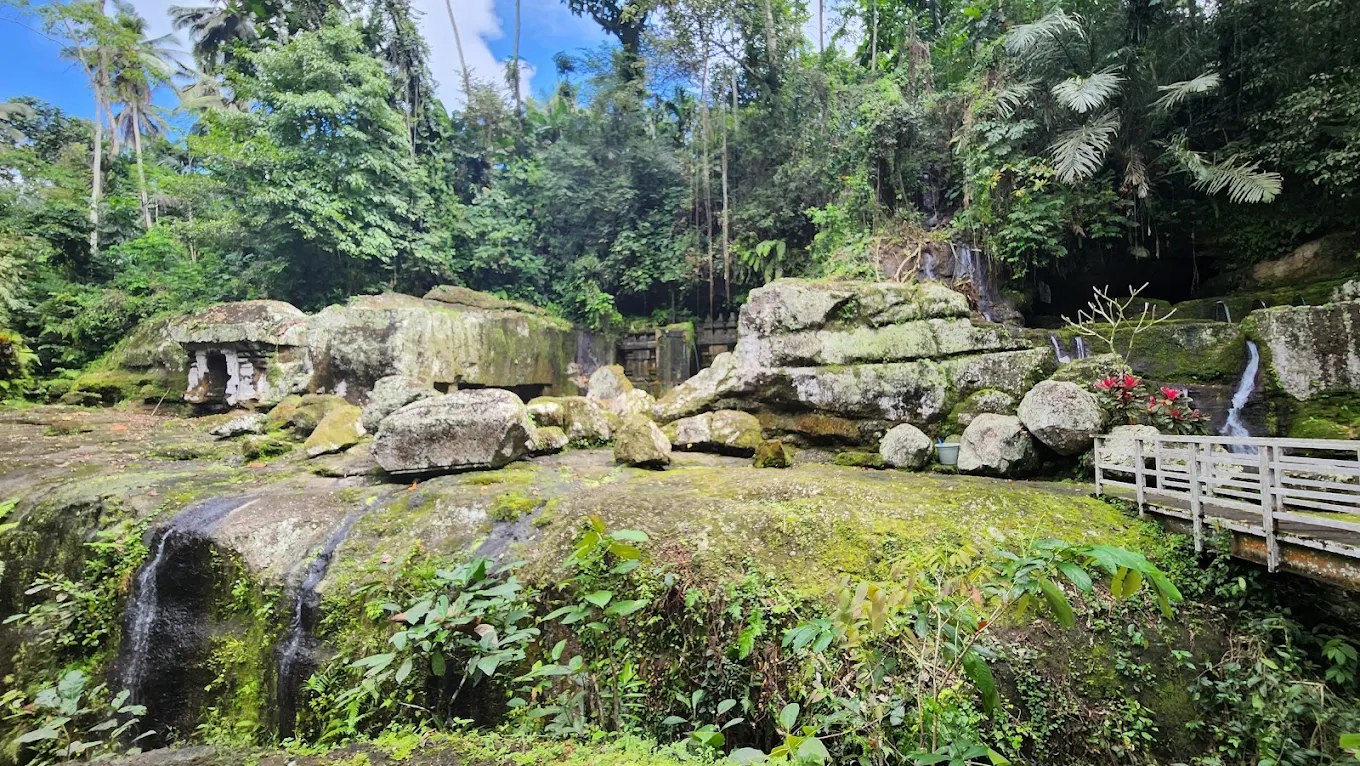
At the end of the journey, volcanic rock cliffs begin to appear. The temple complex stands on these naturally formed rock formations, seemingly blending into the surrounding landscape.

One part that is still in use today is a spring that flows from a natural crevice in the rock into a simple pool.
Balinese Hindus use this water for spiritual activities, including melukat, or purification rituals.
The presence of this spring shows that ancient sites do not necessarily cease to be part of people’s lives after centuries have passed.
At Tegallingah, water remains a link between the heritage of the past and the religious practices of today’s community.
Visitors should also respect the sacred nature of this place, especially when worshippers are performing religious rituals.
Meditation Niches and a Stone Gateway with a Kala Face

The Tebing Tegallingah Temple complex is divided into several sections that follow the shape of the cliffs.
In the upper section, there are niches carved directly into the rock, believed to have been associated with meditation or ascetic practices.
In the main section, two sacred structures carved into the rock stand, each adorned with three lingas, important symbols in the Hindu tradition.
Meanwhile, in the lower section, there is a monumental stone gateway featuring a carved Kala face on its lintel.
For those who have visited Gunung Kawi or Goa Garba, Tegallingah may offer a familiar atmosphere.
However, the character of this place feels more intimate.

While Gunung Kawi captivates visitors with the grandeur of its cliff carvings, Tegallingah offers a quieter space, like a place for contemplation hidden behind dense forest.
One of the interesting aspects of Tegallingah is the story of its rediscovery.
The site was excavated in 1952 by Dutch archaeologist J.C. Krijgsman, after receiving information from local residents about the presence of carved stones near the river.
Although it had been discovered, the history of its construction still leaves many questions unanswered. There are no inscriptions that directly explain who built this complex, when construction began, or to whom the sacred site was dedicated.
Architectural clues link Tegallingah to the development of ancient Balinese cliff temples around the 10th to 12th centuries. However, the complex is believed to have never been fully completed.
Archaeologist A.J. Bernet Kempers, in his book Monumental Bali (1991), highlighted indications that construction of the site may have stopped while work was still underway.

There is also an opinion linking it to the possibility of an earthquake, although the exact cause has yet to be established.
The questions therefore remain open: why did construction of this sacred place stop? Who designed it? And what exactly was Tegallingah’s role in the spiritual life of ancient Balinese society?
The remaining stones have yet to provide all the answers. That is precisely where this site’s appeal lies, as a historical relic that invites visitors to imagine a story that has not yet been fully revealed.
Why Is It Not as Crowded as Goa Gajah?
Tegallingah is only about 3.5 kilometers from Goa Gajah. However, the number of visitors differs considerably.
Made, the site caretaker who has been on duty for around 17 years, says Tegallingah receives only about 100 visitors per month.
This figure is far lower than the approximately 208,000 people recorded as having passed through the gates of Goa Gajah throughout 2025.
The challenging access and its relatively little-known location contribute to this difference. However, the tranquility itself is one of Tegallingah’s main attractions.

This is not a destination to visit in a hurry. Visitors can take their time observing the stone carvings,
enjoying the sound of the river, or simply experiencing the atmosphere of a valley far removed from the hustle and bustle.
Of course, tranquility is no reason to let this site go unnoticed. Preservation and management remain important to protect its historical heritage without losing the natural character that makes it special.
Tips for Visiting Tebing Tegallingah Temple
Before visiting, make sure you are in reasonably good physical condition.
The route to the complex involves around 300 steps, some of which are slippery and not all of which are in good condition.
Wear footwear with good grip and avoid visiting during heavy rain.

Some sections are located along cliff edges without safety railings, so visitors need to exercise extra caution.
This terrain is also not ideal for young children, elderly people with limited mobility, or people with disabilities who have difficulty navigating the path.
Keep the area clean, avoid making noise, and respect worshippers performing rituals.
Regarding entrance tickets, according to information in circulation, the fee for international adult visitors can reach Rp30,000.
Confirm the current rates and access conditions with the site management before setting out.