
Getting to Know Balinese Dwarapala, the Doorway Guardian Statues with Philosophical Meaning
Wigobali.com – There is a sight that may already be very familiar when walking around Bali.
In front of temples, traditional houses, or certain buildings, a pair of statues stands on the right and left sides of the entrance.
Their faces do not always look friendly. Their eyes are made large, their fangs protrude, and their bodies stand upright.
Meanwhile, a mace is held in their hands.
At first glance, the figures seem to be sending a simple message to anyone who wants to enter: go ahead, but don’t just do as you please.
These statues are known as Dwarapala. In simple terms, Dwarapala means a door guardian.
The term comes from the word dwara, meaning door, and pala, meaning guardian.

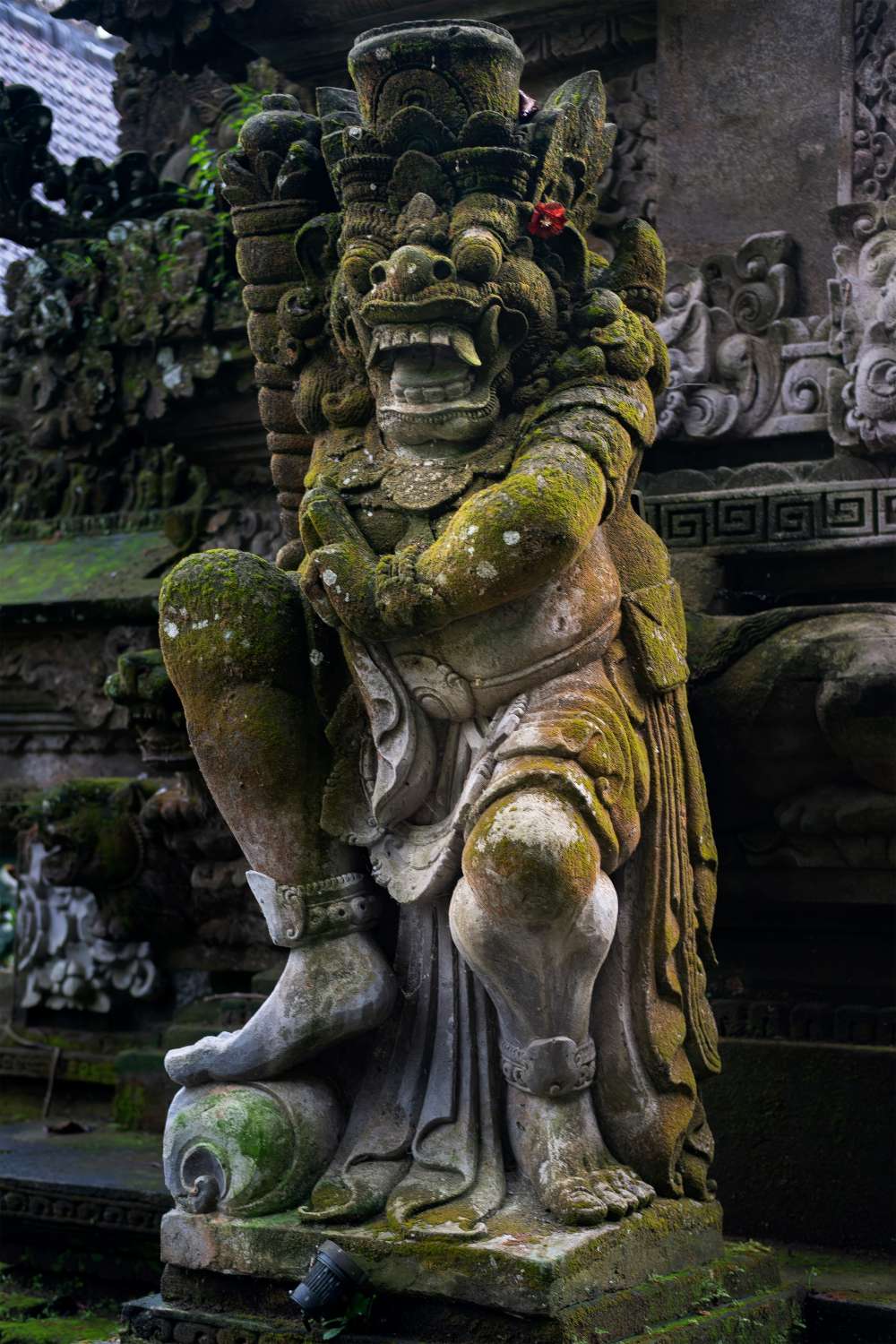
However, in Balinese tradition, their presence goes beyond a decorative function in front of a building.
These Dwarapala are present as part of spatial arrangement,
symbols, as well as reminders of the boundary between the outside space and a space considered more sacred.
Guardians Standing at the Threshold
Dwarapala are usually depicted with strong characteristics.
Their facial expressions are serious, even tending to look fierce.
Their eyes bulge, their fangs are visible, and the mace weapon is an attribute that reinforces their role as guardians.
This depiction is not merely intended to frighten people who come.
In Balinese cultural understanding, Dwarapala are associated with the task of protecting an area from various disturbances.
Some are sekala, namely things that can be seen and physically felt.

There are also niskala, which exist in the realm of spirituality and community beliefs.
Therefore, a pair of Dwarapala standing at a gate seems to mark a boundary.
Outside is a more general space, while after passing through the door, a person enters a space with certain rules and values of sacredness.
The higher the level of sacredness of an area, in some traditions, the higher the status of the guardian symbol placed there.
Not Always a Pair of Identical Statues
Another interesting point is that Dwarapala do not always appear as two statues that are truly identical.
In some Balinese visual traditions, the two figures may have different characteristics, positions, or statuses.
This pair is then associated with the concept of Rwa Bhineda.
A notion about two different elements that complement each other in life.

That is why a pair of Dwarapala in one place can have forms and identities that differ from those in another place.
Some pairs known in Balinese tradition include Subali and Sugriwa, two brother figures in the Ramayana story.
There are also Pan Brayut and Men Brayut, a married couple known in Balinese tradition and visual arts.
Another pair is Merdah and Tualen, punakawan figures who are quite familiar in Balinese culture.
As well as a pair of twin giants that are also widely found in representations of gate guardians.
This means that when we see two statues in front of a building.
We are not always looking at two “security guards” in the same form.
Their identities and characteristics may be connected to the stories, philosophies, or cultural context of the place where the statues are located.

When the Environment Also Shapes the Guardian Figures
Bali also shows how cultural symbols can intertwine with their surrounding environment.
In Uluwatu and Sangeh, for example, the presence of monkeys is a strong part of the landscape and stories of these areas.
It is not surprising that representations of guardian figures in some places then have connections with monkey characteristics.
Here we can see that culture does not always grow in a vacuum.
Instead, it interacts with nature, community stories, the history of a place, and customs that develop from generation to generation.
Thus, Dwarapala in one area may have characteristics that differ from Dwarapala in another area.
There is also a division of positions that carries symbolic meaning.
In some explanations of Balinese Dwarapala. The masculine figure or one considered older.
And having a higher status is placed on the left side of the entrance.

Meanwhile, the feminine figure, or one considered younger and having a lower status.
Is placed on the right and associated with the lower realm.
This division becomes part of the way Balinese people understand balance and the relationship between different elements.
Thus, right and left in front of a gate are not merely matters of placing statues so that they look symmetrical.
There is an idea of balance at work behind it.
In the beliefs of some communities, Dwarapala are also regarded as figures with a selective function.
There is a belief that bad intentions can become an obstacle for someone who wishes to enter a sacred area.
But at the same time, Dwarapala are not only placed as threatening figures.
They are also understood as receivers, guardians, and guides.
Their presence can be interpreted as a reminder for someone to arrange their attitude and intentions before entering a space that has sacred value.
In other words, it is not only the door that is being guarded.

There is also the human attitude that is expected to change when crossing that threshold.
Interestingly, respect for Dwarapala does not always depend on the physical presence of the statues.
In Balinese Hindu religious practices, offerings may be placed around the door or certain parts as a form of respect.
Even in buildings that do not have Dwarapala statues.
Some people still make offerings on both sides of the door as part of local beliefs and ceremonial practices.
For people who come as tourists, perhaps the first thing they see is simply a pair of statues with fierce faces.
But after learning the context, Balinese gates become somewhat different to look at.
Perhaps that is also what makes Bali always hold stories even in something that initially looks simple.

Including two figures standing silently on the right and left of the door.
Dwarapala have become part of the way Bali tells anyone who comes.
Before entering a space, it is a good idea to know how one should behave inside it.